Connection — Haifa, Israel
About
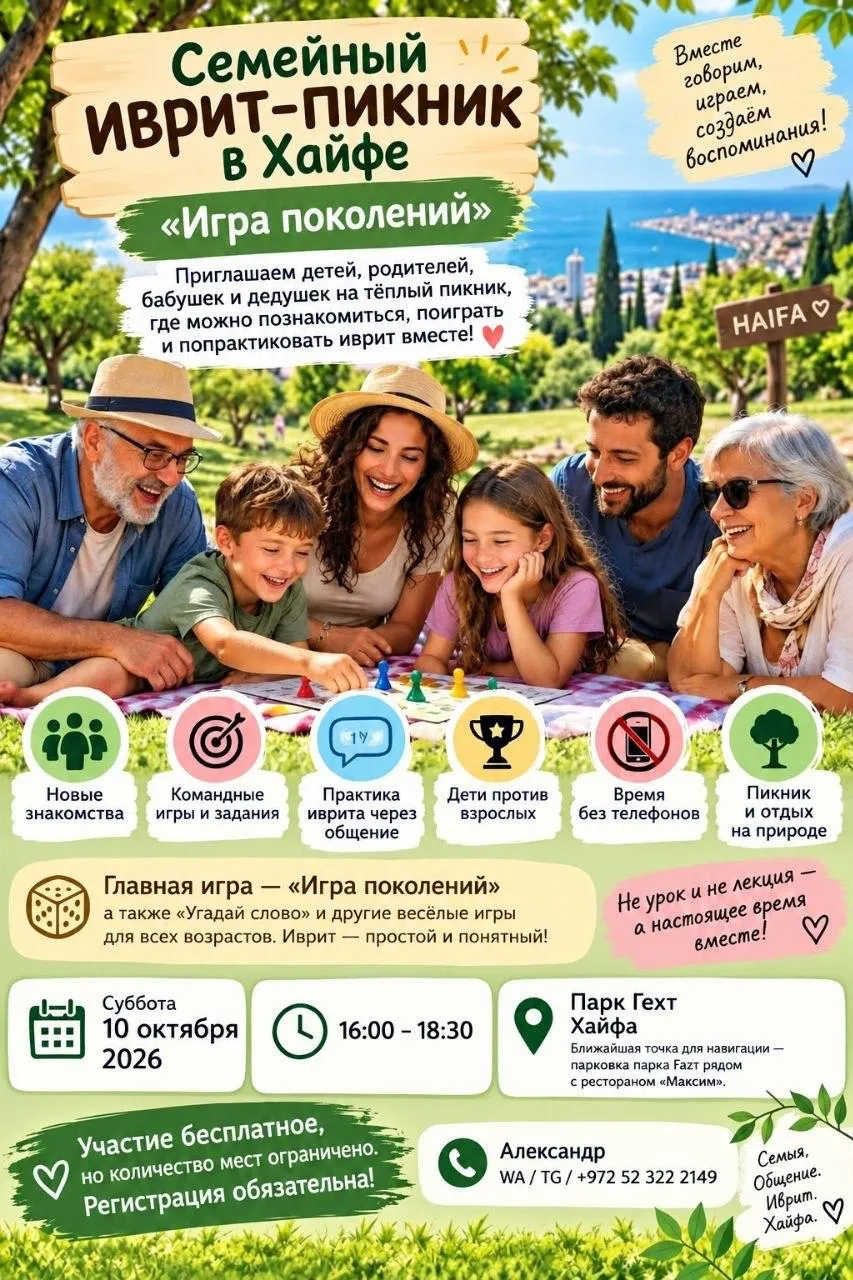
Family Hebrew Picnic: "Game of Generations" 🗓 20 June 2026 / 26 September 2026 / 10 October 2026 | 🕧 16:00 | 📍 Hecht Park, Haifa (link) A family Hebrew picnic for Russian-speaking families with children, parents, grandparents. Participants can expect introductions, team games, “Game of Generations”, “Guess the Word” and simple conversational practice in Hebrew. The format suits different language levels; recommended age for children is 8–14 years. Bring a dish for the shared table, a blanket or chair, water and a hat. Free entry, registration required: Alexander WA / TG / +972 52 322 2149 Language: Russian, Hebrew Subscribe to IKudaИврит. Hebrew can be learned by everyone! (telegram link)
Q&A:
Most questions are answered by the organizer, but community members can also answer.
Contacts
Kiddodoo MessagesSchedule & Booking:
We verified the schedule less than 24 hours ago. Book with confidence, guaranteed best price.
Skills & Interests
Organized activities in which children and caregivers participate together, such as crafts, games, quests, movement, or family camps. The defining element is shared participation and relationship time, not a particular subject.
more «familytime» →What it is: Connection is the child's current need for meaningful social contact, inclusion, and belonging. Why it matters: meeting it can support security, willingness to participate, shared enjoyment, and the sense of having a place with other people. When it rises: the child may feel apart, new to a group, insufficiently seen, or eager to share an experience. When it lowers: responsive interaction, companionship, or genuine shared participation may have helped meet the need; a lower need does not mean the child wants isolation. Why this is the same: friendship, belonging, companionship, socializing, and shared participation all seek meaningful connection. Why this is different: Support seeks help or reassurance, Loneliness is the feeling of unwanted disconnection, and Communication and Collaboration are developable abilities.
more «Connection» →One-time events and activities for weekends or leisure: plays and movie screenings, workshops, lectures, day hikes and trips, fairs, shows, fun runs, competitions, quests. What's there for us this weekend?
more «upcoming events» →Expressing and receiving meaning appropriately; includes speaking and active listening.
more «Communication» →Beginner Hebrew lessons that practise listening, speaking, vocabulary, reading, or writing. Use this extracurricular tag when Hebrew is learned outside the standard school curriculum.
more «hebrew basics» →Where?

Run activities for kids?
Reach families who are a real match. Post your classes, camps and programs to the open catalog. Kiddodoo shows them to parents whose children are genuinely exploring what you offer, not just anyone within 5 km.
Get startedThis page is from the Kid-do-doo app. Install the app to see the details.
Parenting, made clearer — and less scattered
Understand what may be happening with your child — and find real-world ways to support the next step.
This page is from the Kid-do-doo app. Install the app to see the details.
Parenting, made clearer — and less scattered
Understand what may be happening with your child — and find real-world ways to support the next step.
Schedule:
We verified the schedule less than 24 hours ago. Book with confidence, guaranteed best price.

About
Friends, our walk in Haifa will definitely take place on June 10, 2026. We look forward to seeing everyone at 18:30 at Merkaz Ziv (meeting point in the description). NB: if you have battery-powered lanterns or candles, please bring them with you. We will be very grateful 💚 Register without fuss on KiddoDu or in the organizer's direct: telegram link
Q&A:
Most questions are answered by the organizer, but community members can also answer.
Contacts
Kiddodoo MessagesSchedule & Booking:
We verified the schedule less than 24 hours ago. Book with confidence, guaranteed best price.
Skills & Interests
Capabilities for communication, understanding others, and coordinating within relationships and groups; excludes temperament labels and unpracticed moral claims.
more «Social and communication capacities» →What it is: Connection is the child's current need for meaningful social contact, inclusion, and belonging. Why it matters: meeting it can support security, willingness to participate, shared enjoyment, and the sense of having a place with other people. When it rises: the child may feel apart, new to a group, insufficiently seen, or eager to share an experience. When it lowers: responsive interaction, companionship, or genuine shared participation may have helped meet the need; a lower need does not mean the child wants isolation. Why this is the same: friendship, belonging, companionship, socializing, and shared participation all seek meaningful connection. Why this is different: Support seeks help or reassurance, Loneliness is the feeling of unwanted disconnection, and Communication and Collaboration are developable abilities.
more «Connection» →What it is: Movement is the child's current need for physical action or an outlet for bodily energy. Why it matters: meeting it can support bodily comfort, regulation, attention, and readiness for other kinds of participation. When it rises: the body may have been still for too long or may have energy that needs an active outlet. When it lowers: active play, sport, walking, stretching, or another suitable opportunity may have helped meet the need. Why this is the same: wanting to run, move, stretch, or use the body points to the same need for physical action. Why this is different: Restlessness is an uncomfortable feeling that may accompany the need, while Challenge is a need for achievable difficulty rather than movement itself.
more «Movement» →Be it city or nature walks — with an engaging guide, a scientist, a scavenger hunt, games along the way, or elements of outdoor sketching — hikes and walks are a wonderful way to gradually expand a child's independence. They give children more time outdoors in a free and friendly environment with peers, spark their interest in biology, archaeology, architecture, or hiking, and simply help families spend great time together.
more «walks and hikes» →Coordinating contributions toward a shared result; includes teamwork and cooperation.
more «Collaboration» →What it is: Joy is a present feeling of happiness, pleasure, or warm enjoyment. Why it matters: it can support engagement, connection, exploration, and a wish to return to an experience. When it rises: positive enjoyment becomes more noticeable or intense. When it lowers: the child may simply feel more neutral; it does not mean Sadness has risen. Why this is the same: happiness, delight, and pleasure belong here when they describe the child's current positive feeling. Why this is different: Excitement centres on energized anticipation, Fun is a personal judgement about an activity, and lasting wellbeing is broader than a current feeling.
more «Joy» →Where?

Run activities for kids?
Reach families who are a real match. Post your classes, camps and programs to the open catalog. Kiddodoo shows them to parents whose children are genuinely exploring what you offer, not just anyone within 5 km.
Get startedThis page is from the Kid-do-doo app. Install the app to see the details.
Parenting, made clearer — and less scattered
Understand what may be happening with your child — and find real-world ways to support the next step.
This page is from the Kid-do-doo app. Install the app to see the details.
Parenting, made clearer — and less scattered
Understand what may be happening with your child — and find real-world ways to support the next step.
Schedule:
We verified the schedule less than 24 hours ago. Book with confidence, guaranteed best price.