Movement — Montenegro


About
Organizer: Lemonade - движение и танцы Gymnastics for beginners (ages 8–12) on Wednesdays and Fridays at 15:45 with coach Polina. Enrollment is open; the start date will be announced in the chat as the group fills. This announcement was found and posted by KiddoDoo editors. Like it and we will find out all the details and exact schedule. Gymnastics: Wednesday and Friday at 15:45, beginners 8–12 years, Polina Enrollment is open! All current pass holders need to choose a group again. We will announce the start of groups separately in this chat as each fills up.
Q&A:
Most questions are answered by the organizer, but community members can also answer.
Contacts
Kiddodoo MessagesSchedule & Booking:
We verified the schedule less than 24 hours ago. Book with confidence, guaranteed best price.
Skills & Interests
We're still working on this description. A detailed overview will be available soon.
more «gymnastics» →Recognizing body position, movement, and bodily signals; not balance or coordination.
more «Body awareness» →What it is: Movement is the child's current need for physical action or an outlet for bodily energy. Why it matters: meeting it can support bodily comfort, regulation, attention, and readiness for other kinds of participation. When it rises: the body may have been still for too long or may have energy that needs an active outlet. When it lowers: active play, sport, walking, stretching, or another suitable opportunity may have helped meet the need. Why this is the same: wanting to run, move, stretch, or use the body points to the same need for physical action. Why this is different: Restlessness is an uncomfortable feeling that may accompany the need, while Challenge is a need for achievable difficulty rather than movement itself.
more «Movement» →Changing body position or direction quickly and effectively; not general coordination.
more «Agility» →Controlled synchronization of body parts; not balance or rapid direction change.
more «Coordination» →Where?

Run activities for kids?
Reach families who are a real match. Post your classes, camps and programs to the open catalog. Kiddodoo shows them to parents whose children are genuinely exploring what you offer, not just anyone within 5 km.
Get startedThis page is from the Kid-do-doo app. Install the app to see the details.
Parenting, made clearer — and less scattered
Understand what may be happening with your child — and find real-world ways to support the next step.
This page is from the Kid-do-doo app. Install the app to see the details.
Parenting, made clearer — and less scattered
Understand what may be happening with your child — and find real-world ways to support the next step.
Schedule:
We verified the schedule less than 24 hours ago. Book with confidence, guaranteed best price.
About
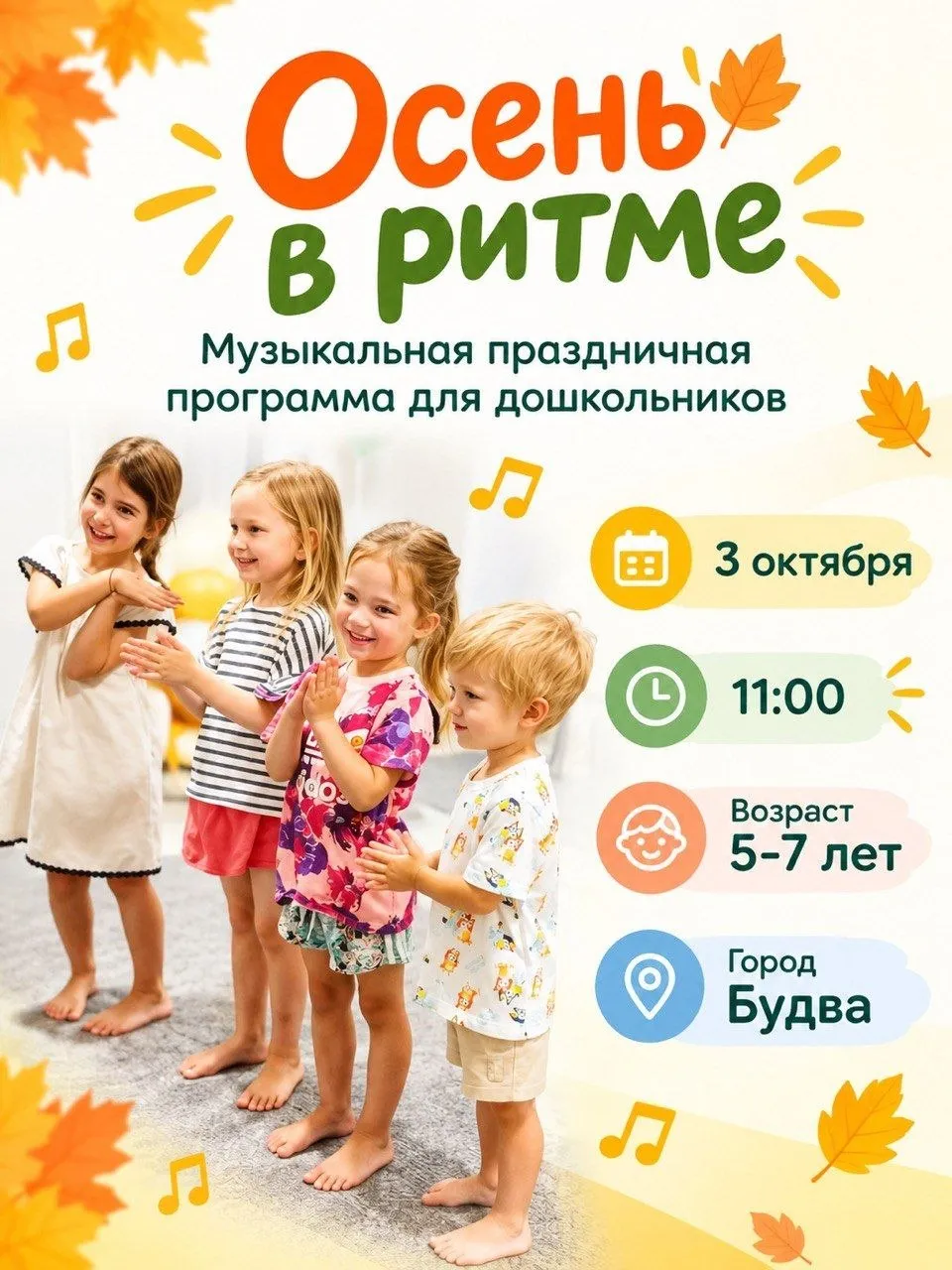
Organizer: Первая школа мюзикла On October 3 at 11:00 in Budva the First School of Musical hosts the “Autumn in Rhythm” celebration for children and their parents. The program includes rhythm experiments, dancing with autumn leaves, creating an orchestra, turning rain sounds into music, dance games and improvisation. No need to learn songs or dances in advance. Entrance €20, registration via the provided link. This announcement was found and posted by KiddoDoo editors. Like it and we will find out all the details and exact schedule. On October 3 at 11:00 in Budva an event will take place at the First School of Musical. Dear parents, we invite you and your children to the “Autumn in Rhythm” celebration 😊 At the Musical School we organize “Autumn in Rhythm” — a musical festive program where you do not need to learn songs, poems or dances in advance. Here every child can be themselves, try, invent and play with music. We will: 🎵 move to music and experiment with rhythm; 🍁 dance with autumn leaves; 🥁 create our own orchestra; 🌧️ turn the sounds of rain into music; 💃 play dance games; 🎤 improvise; ✨ and, of course, hold a big autumn musical party! Entrance: 20 EUR Registration: telegram link 📍 First School of Musical (link)
Q&A:
Most questions are answered by the organizer, but community members can also answer.
Contacts
Kiddodoo MessagesSchedule & Booking:
We verified the schedule less than 24 hours ago. Book with confidence, guaranteed best price.
Skills & Interests
What it is: Expression is the child's current need for an outlet for feelings, ideas, experiences, imagination, or identity. Why it matters: meeting it can help a child process experience, make themselves understood, exercise agency, and contribute something personally meaningful. When it rises: the child may have something they want to communicate, create, show, or embody without a suitable outlet. When it lowers: verbal, creative, musical, physical, dramatic, or symbolic expression may have helped meet the need. Why this is the same: these different forms belong together because each gives inner experience an outward form. Why this is different: Communication and Creativity are transferable abilities that can develop through expressive activities; they are not the child's current need for an outlet.
more «Expression» →Activities centered around music that develop listening skills, sense of rhythm, attention, memory, coordination, musicality, and self-expression — through listening and playful interaction as well as learning music theory, playing instruments, or singing. Over time, musicality becomes more than a skill: it becomes a way to experience joy, process emotions, feel part of a group, and find support in music throughout life.
more «music» →What it is: Movement is the child's current need for physical action or an outlet for bodily energy. Why it matters: meeting it can support bodily comfort, regulation, attention, and readiness for other kinds of participation. When it rises: the body may have been still for too long or may have energy that needs an active outlet. When it lowers: active play, sport, walking, stretching, or another suitable opportunity may have helped meet the need. Why this is the same: wanting to run, move, stretch, or use the body points to the same need for physical action. Why this is different: Restlessness is an uncomfortable feeling that may accompany the need, while Challenge is a need for achievable difficulty rather than movement itself.
more «Movement» →We're still working on this description. A detailed overview will be available soon.
more «singing» →Includes vocal training, stage movement, and acting. For many children, taking part in a musical becomes a foundation for future professional growth. Helps develop confidence, public-speaking and stage-presence skills, as well as discipline and musicality. These classes are held on a regular basis and follow a structured schedule — typically 2–3 times per week.
more «musical» →One-time events and activities for weekends or leisure: plays and movie screenings, workshops, lectures, day hikes and trips, fairs, shows, fun runs, competitions, quests. What's there for us this weekend?
more «upcoming events» →What it is: Joy is a present feeling of happiness, pleasure, or warm enjoyment. Why it matters: it can support engagement, connection, exploration, and a wish to return to an experience. When it rises: positive enjoyment becomes more noticeable or intense. When it lowers: the child may simply feel more neutral; it does not mean Sadness has risen. Why this is the same: happiness, delight, and pleasure belong here when they describe the child's current positive feeling. Why this is different: Excitement centres on energized anticipation, Fun is a personal judgement about an activity, and lasting wellbeing is broader than a current feeling.
more «Joy» →Where?
Run activities for kids?
Reach families who are a real match. Post your classes, camps and programs to the open catalog. Kiddodoo shows them to parents whose children are genuinely exploring what you offer, not just anyone within 5 km.
Get startedThis page is from the Kid-do-doo app. Install the app to see the details.
Parenting, made clearer — and less scattered
Understand what may be happening with your child — and find real-world ways to support the next step.
This page is from the Kid-do-doo app. Install the app to see the details.
Parenting, made clearer — and less scattered
Understand what may be happening with your child — and find real-world ways to support the next step.
Schedule:
We verified the schedule less than 24 hours ago. Book with confidence, guaranteed best price.

About
Organizer: Детский центр Red Panda (Igalo) Active games for children will take place from 14:00 to 15:00 — a session of physical play and activities. Price follows the hourly rate. This announcement was found and posted by KiddoDoo editors. Like it and we will find out all the details and exact schedule. 2026-09-19 14:00-15:00 active games 2026-10-10 14:30-15:30 (Активные игры с шариками) Price: 3€ /hour We welcome everyone. Sign up hassle-free on Kiddodoo or by direct message to the organizer: telegram link
Q&A:
Most questions are answered by the organizer, but community members can also answer.
Contacts
Kiddodoo MessagesSchedule & Booking:
We verified the schedule less than 24 hours ago. Book with confidence, guaranteed best price.
Skills & Interests
Capabilities of body control and physical effort practiced through movement; excludes health outcomes, sport techniques, and mental or social qualities.
more «Physical capacities» →Controlled synchronization of body parts; not balance or rapid direction change.
more «Coordination» →What it is: Movement is the child's current need for physical action or an outlet for bodily energy. Why it matters: meeting it can support bodily comfort, regulation, attention, and readiness for other kinds of participation. When it rises: the body may have been still for too long or may have energy that needs an active outlet. When it lowers: active play, sport, walking, stretching, or another suitable opportunity may have helped meet the need. Why this is the same: wanting to run, move, stretch, or use the body points to the same need for physical action. Why this is different: Restlessness is an uncomfortable feeling that may accompany the need, while Challenge is a need for achievable difficulty rather than movement itself.
more «Movement» →What it is: Joy is a present feeling of happiness, pleasure, or warm enjoyment. Why it matters: it can support engagement, connection, exploration, and a wish to return to an experience. When it rises: positive enjoyment becomes more noticeable or intense. When it lowers: the child may simply feel more neutral; it does not mean Sadness has risen. Why this is the same: happiness, delight, and pleasure belong here when they describe the child's current positive feeling. Why this is different: Excitement centres on energized anticipation, Fun is a personal judgement about an activity, and lasting wellbeing is broader than a current feeling.
more «Joy» →Where?

Run activities for kids?
Reach families who are a real match. Post your classes, camps and programs to the open catalog. Kiddodoo shows them to parents whose children are genuinely exploring what you offer, not just anyone within 5 km.
Get startedThis page is from the Kid-do-doo app. Install the app to see the details.
Parenting, made clearer — and less scattered
Understand what may be happening with your child — and find real-world ways to support the next step.
This page is from the Kid-do-doo app. Install the app to see the details.
Parenting, made clearer — and less scattered
Understand what may be happening with your child — and find real-world ways to support the next step.
Schedule:
We verified the schedule less than 24 hours ago. Book with confidence, guaranteed best price.