
About
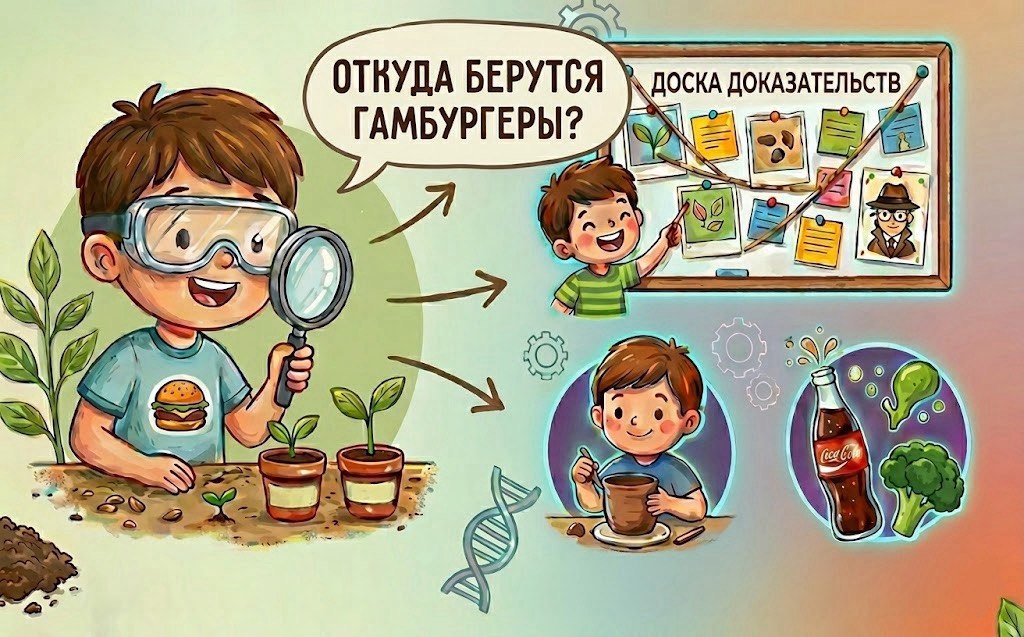
🖇Enrollment is open for a phenomenon-oriented learning club for preschoolers We take everyday “phenomena” and turn them into big discoveries. A child will stop just asking “why?” and will learn to investigate the world like a real scientist—through observation, experiments and creativity. Dear parents! Imagine: you and your child go to McDonald’s, and your child suddenly asks: Mom, where do hamburgers come from? Over 8 weeks the kids will learn how the world works. For our big investigation we will take 3 items: a hamburger, a soda and a plastic soda cup. Did you know that a McCombo is a real chest of secrets? We will dive into its depths: "grow" hamburgers from seeds and become real agronomists, learn where cups come from and finally learn why soda is tasty but harmful to health. What we will do: 🖇Create a big evidence board to investigate our phenomena like real detectives 🖇Learn to grow vegetables from seeds 🖇Make clay pots with our own hands 🖇Learn how cups are made and understand why it is important to protect the environment. We will also learn to recycle materials 🖇Find out why soda fizzes, why it tastes good and at the same time is harmful to health 🖇Learn to observe the world, find answers to interesting questions and, of course, create Result Your little why-asker will turn into a young scientist who can explain how the world works! 2 classes per week of 70 minutes each. Wednesday - 16:00 Saturday - 12:00 Age: 5–6 years Start: April 21 (Wednesday) Place: Adriatic Open, Bar Price: 100 euro / month Registration: https://t.me/georgii_zlobin https://t.me/adriatic_open_class Sign up fuss-free in KiddoDu or direct to the organizer: https://t.me/solnca13
Q&A:
Most questions are answered by the organizer, but community members can also answer.
Contacts
Kiddodoo MessagesSchedule & Booking:
We verified the schedule less than 24 hours ago. Book with confidence, guaranteed best price.
Skills & Interests
Activities based on educational approaches to early childhood development, focusing on individual pace, independence, and learning through environment and hands-on activity.
more «early learning approaches» →Сhildren explore science through hands-on experience: observing, mixing, testing hypotheses, and discovering cause-and-effect relationships. They satisfy children’s natural curiosity, develop logical thinking and fine motor skills, and show that science can be practical, understandable, and engaging.
more «lab experiments» →Science, Technology, Engineering, Mechanics — practical exploration of engineering thinking and creative construction. Children experiment, design and build structures, test their ideas, and learn how simple mechanisms and processes work. These activities develop logical thinking, focus and perseverance, as well as spatial imagination.
more «stem» →Activities that help participants become aware of their connection with nature, develop a mindful and respectful attitude toward it, take part in environmental initiatives, and gain a deeper understanding of natural ecosystems and how modern technologies can contribute to their preservation.
more «ecology» →Where?

Share your activity on Kid-do-doo?
Start fast. Turn a post you already have into a simple listing on Kiddodoo. Make it visible to parents. Improve it later.
Get startedThis is a page from the Kid-do-doo app — a navigator for parents in the world of kids' activities. To see the full information you need to install the app and join.
Schedule:
We verified the schedule less than 24 hours ago. Book with confidence, guaranteed best price.