
About
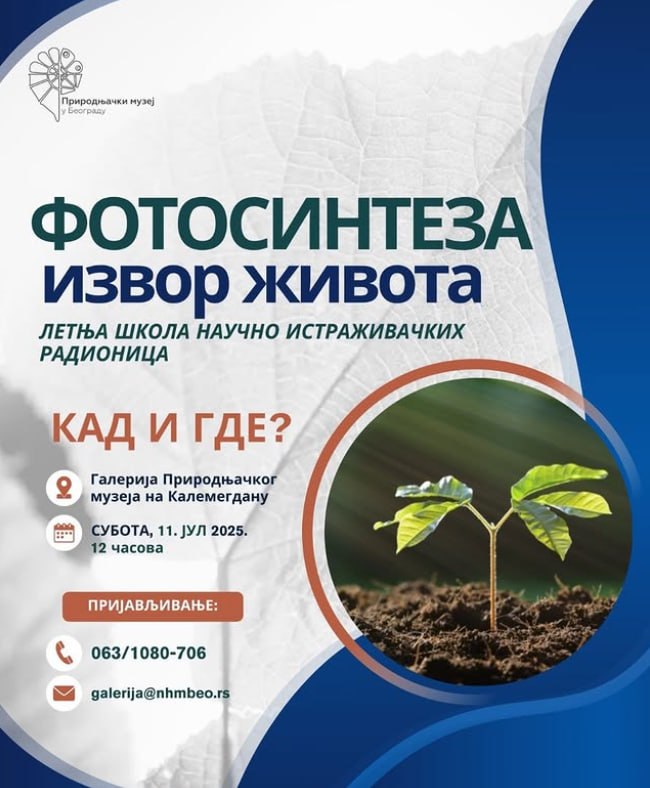
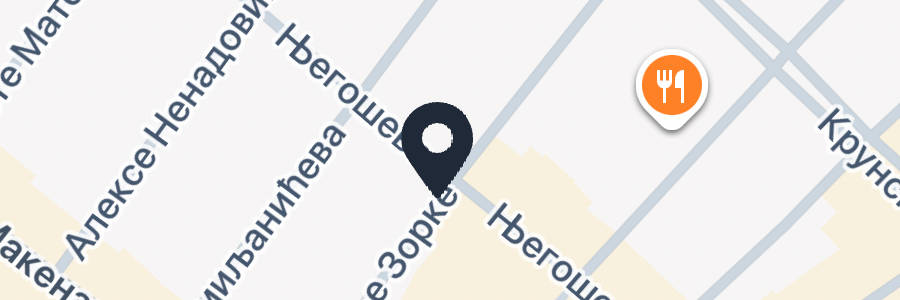
Organizer: Prirodnjacki muzej (Natural History Museum, Belgrade) On Saturday a scientific research masterclass 'Photosynthesis' will take place at the Natural History Museum gallery in Kalemegdan for children aged 8–12. The session, led by Dr. Lazar Novakovic, features interactive experiments demonstrating oxygen release, plant pigments and starch formation in leaves. Pre-registration by email or phone is required. This announcement was found and posted by KiddoDoo editors. Like it and we will find out all the details and exact schedule. On Saturday a scientific research masterclass for children "Photosynthesis" will take place in the gallery of the Natural History Museum at Kalemegdan. The event opens the new season of the Museum's Summer School. Lecturer: Dr. Lazar Novakovic. The program is intended for participants aged 8 to 12 and includes a series of interactive experiments. Children will observe oxygen release, plant pigments and starch formation in leaves, and learn why photosynthesis is one of the most important processes for sustaining life on Earth. To participate in the masterclass, please register in advance by email galerija@nhmbeo.rs or by phone +38163-1080-706. Admission by registration Time: 12:00 Place: Prirodnjacki muzej (Natural History Museum) link Source: telegram link
Q&A:
Most questions are answered by the organizer, but community members can also answer.
Contacts
Kiddodoo MessagesSchedule & Booking:
We verified the schedule less than 24 hours ago. Book with confidence, guaranteed best price.
Skills & Interests
Сhildren explore science through hands-on experience: observing, mixing, testing hypotheses, and discovering cause-and-effect relationships. They satisfy children’s natural curiosity, develop logical thinking and fine motor skills, and show that science can be practical, understandable, and engaging.
more «lab experiments» →Although biology is not usually taught as a separate subject in primary school, children are often fascinated by biologists’ stories, learning to observe the microworld through a microscope and to recognize different species of plants and animals, learning secrets about everything. Adding biology elements to walks, activities, and experiments is not only engaging, but also helps spark a lasting interest in the natural sciences.
more «biology» →Science, Technology, Engineering, Mechanics — practical exploration of engineering thinking and creative construction. Children experiment, design and build structures, test their ideas, and learn how simple mechanisms and processes work. These activities develop logical thinking, focus and perseverance, as well as spatial imagination.
more «stem» →Activities that help participants become aware of their connection with nature, develop a mindful and respectful attitude toward it, take part in environmental initiatives, and gain a deeper understanding of natural ecosystems and how modern technologies can contribute to their preservation.
more «ecology» →Where?
Run activities for kids?
Reach families who are a real match. Post your classes, camps and programs to the open catalog. Kiddodoo shows them to parents whose children are genuinely exploring what you offer, not just anyone within 5 km.
Get startedThis page is from the Kid-do-doo app. Install the app to see the details.
Parenting, made clearer — and less scattered
Understand what may be happening with your child — and find real-world ways to support the next step.
This page is from the Kid-do-doo app. Install the app to see the details.
Parenting, made clearer — and less scattered
Understand what may be happening with your child — and find real-world ways to support the next step.
Schedule:
We verified the schedule less than 24 hours ago. Book with confidence, guaranteed best price.