
About
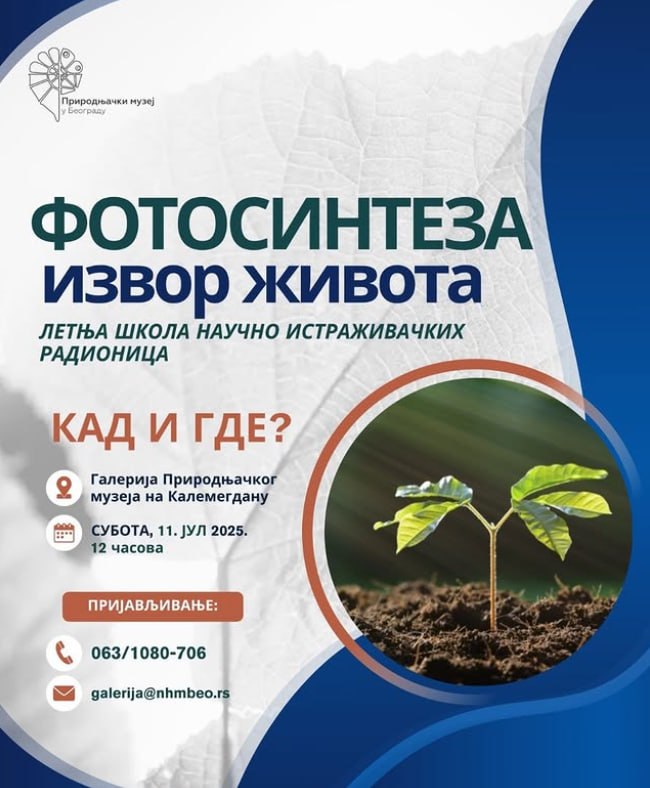
Organizator: Prirodnjacki muzej (Natural History Museum, Belgrade) W sobotę w galerii Muzeum Historii Naturalnej na Kalemegdanie odbędzie się naukowo-badawczy warsztat dla dzieci „Fotosynteza”. Wydarzenie otwiera sezon Letniej Szkoły muzeum, wykładowcą jest dr Lazar Novakovic. Program dla uczestników w wieku 8–12 lat obejmuje interaktywne eksperymenty: uwalnianie tlenu, barwniki roślinne i powstawanie skrobi w liściach. To ogłoszenie zostało znalezione i opublikowane przez redaktorów KiddoDoo. Polub je, a poznamy wszystkie szczegóły i dokładny harmonogram. W sobotę w galerii Muzeum Historii Naturalnej na Kalemegdanie odbędzie się naukowo-badawczy warsztat dla dzieci "Fotosynteza". Wydarzenie otwiera nowy sezon Letniej Szkoły muzeum. Wykładowcą będzie dr Lazar Novakovic. Program przeznaczony jest dla uczestników w wieku od 8 do 12 lat i obejmuje serię interaktywnych eksperymentów. Dzieci zobaczą procesy uwalniania tlenu, barwniki roślinne i powstawanie skrobi w liściach, a także dowiedzą się, dlaczego fotosynteza jest jednym z najważniejszych procesów podtrzymujących życie na Ziemi. Aby wziąć udział w warsztacie, należy wcześniej zarejestrować się mailowo na adres galerija@nhmbeo.rs lub telefonicznie pod numerem 063-1080-706. Wstęp po rejestracji Czas: 12:00 Miejsce: Prirodnjacki muzej link Źródło: telegram link
Q&A:
Most questions are answered by the organizer, but community members can also answer.
Contacts
Kiddodoo MessagesSchedule & Booking:
We verified the schedule less than 24 hours ago. Book with confidence, guaranteed best price.
Skills & Interests
Сhildren explore science through hands-on experience: observing, mixing, testing hypotheses, and discovering cause-and-effect relationships. They satisfy children’s natural curiosity, develop logical thinking and fine motor skills, and show that science can be practical, understandable, and engaging.
more «lab experiments» →Although biology is not usually taught as a separate subject in primary school, children are often fascinated by biologists’ stories, learning to observe the microworld through a microscope and to recognize different species of plants and animals, learning secrets about everything. Adding biology elements to walks, activities, and experiments is not only engaging, but also helps spark a lasting interest in the natural sciences.
more «biology» →Science, Technology, Engineering, Mechanics — practical exploration of engineering thinking and creative construction. Children experiment, design and build structures, test their ideas, and learn how simple mechanisms and processes work. These activities develop logical thinking, focus and perseverance, as well as spatial imagination.
more «stem» →Activities that help participants become aware of their connection with nature, develop a mindful and respectful attitude toward it, take part in environmental initiatives, and gain a deeper understanding of natural ecosystems and how modern technologies can contribute to their preservation.
more «ecology» →Where?

Run activities for kids?
Reach families who are a real match. Post your classes, camps and programs to the open catalog. Kiddodoo shows them to parents whose children are genuinely exploring what you offer, not just anyone within 5 km.
Get startedThis page is from the Kid-do-doo app. Install the app to see the details.
Parenting, made clearer — and less scattered
Understand what may be happening with your child — and find real-world ways to support the next step.
This page is from the Kid-do-doo app. Install the app to see the details.
Parenting, made clearer — and less scattered
Understand what may be happening with your child — and find real-world ways to support the next step.
Schedule:
We verified the schedule less than 24 hours ago. Book with confidence, guaranteed best price.