Self-awareness — Serbia

About
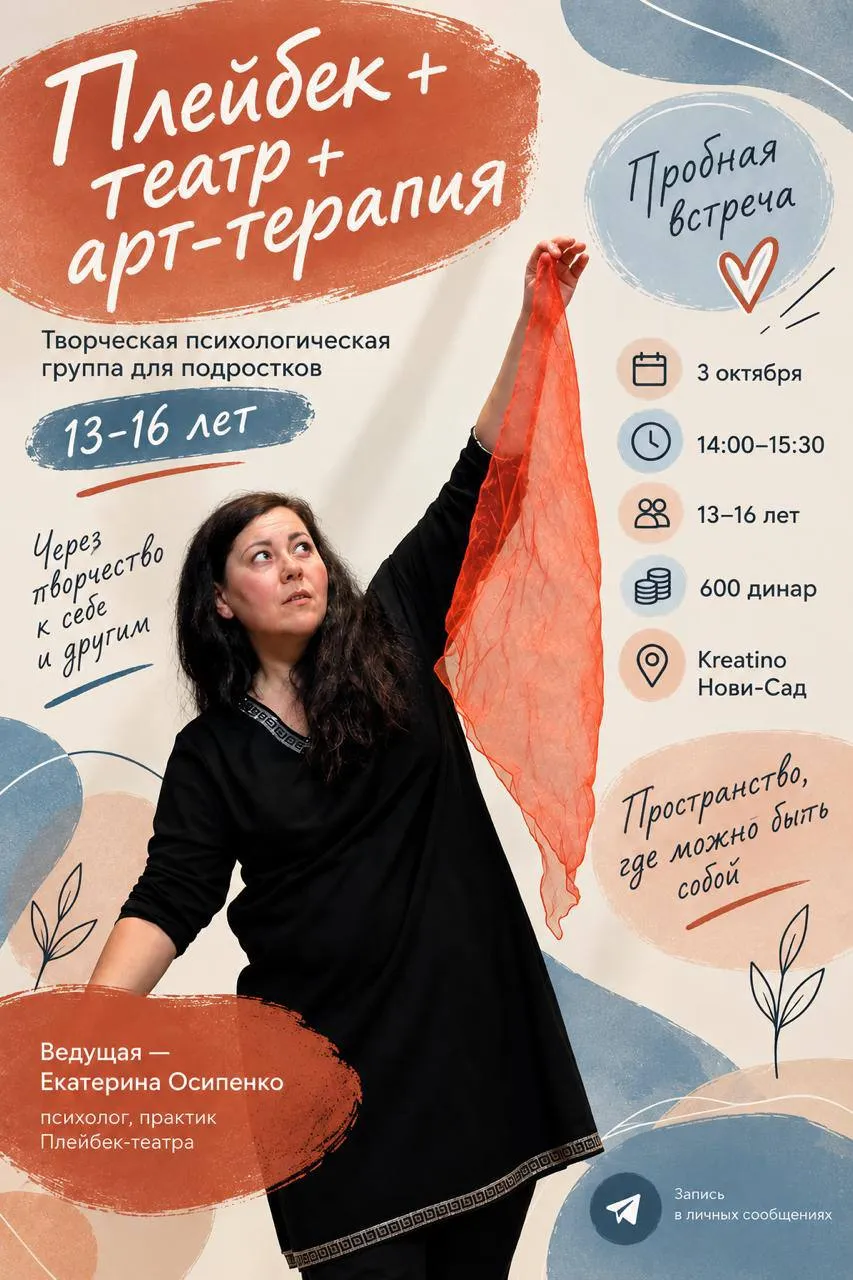
Organizer: Екатерина Осипенко A trial meeting of a new creative psychological group for teenagers aged 13–16. Sessions use theatre, playback, movement, drawing and improvisation to explore self-identity, peer relationships and boundaries. The facilitator is psychologist and Playback Theatre practitioner Ekaterina Osipenko. The trial meeting is on October 3, 14:00–15:30 at Kreatino. This announcement was found and posted by KiddoDoo editors. Like it and we will find out all the details and exact schedule. 🎭 Playback + theatre + art therapy for teenagers 13–16 We invite teenagers to a trial meeting of a new creative psychological group. Adolescence is a time with many questions about oneself and others: Who am I? What do I like and want? How do others see me? Where is my place among peers? How to stay yourself while being in relationships with others? In the group we will explore these questions not only through conversation but also through theatre, Playback, movement, drawing, images, roles and improvisation. 🎬 Theatre and Playback here are not about becoming an actor. You don’t need to know how to perform on stage or move nicely. Theatrical play and creativity become a way to get to know yourself better, try different roles, express feelings and gain new experience of interacting with others. At the meetings teenagers will be able to: — get to know and understand themselves and their feelings better; — explore relationships with peers; — notice their own boundaries and the boundaries of others; — try different ways of expressing themselves and interacting; — find their strengths and inner supports; — gain experience of support and belonging to a group; — be seen and heard while remaining themselves. Each meeting is dedicated to one of the important topics of growing up: me and my feelings, friendship and relationships, boundaries, conflicts, family, studies and expectations, choice, independence and finding one’s place among others. 👩🎨 Facilitator — Ekaterina Osipenko, psychologist, Playback Theatre practitioner. In work with teenagers she combines psychology, movement, creativity, play and improvisation. ✨ Trial meeting — October 3 👥 Age: 13–16 📅 Date: October 3 ⏰ Time: 14:00–15:30 💰 Trial meeting fee: 600 dinar 📍 Kreatino, 15 Novi Sad (link) 💌 Details and registration telegram link #реклама
Q&A:
Most questions are answered by the organizer, but community members can also answer.
Contacts
Kiddodoo MessagesSchedule & Booking:
We verified the schedule less than 24 hours ago. Book with confidence, guaranteed best price.
Skills & Interests
Managing emotional responses constructively; not suppressing emotion or controlling every impulse.
more «Emotional regulation» →Capabilities for communication, understanding others, and coordinating within relationships and groups; excludes temperament labels and unpracticed moral claims.
more «Social and communication capacities» →Recognizing one's emotions, strengths, needs, and reactions; not body awareness.
more «Self-awareness» →What it is: Movement is the child's current need for physical action or an outlet for bodily energy. Why it matters: meeting it can support bodily comfort, regulation, attention, and readiness for other kinds of participation. When it rises: the body may have been still for too long or may have energy that needs an active outlet. When it lowers: active play, sport, walking, stretching, or another suitable opportunity may have helped meet the need. Why this is the same: wanting to run, move, stretch, or use the body points to the same need for physical action. Why this is different: Restlessness is an uncomfortable feeling that may accompany the need, while Challenge is a need for achievable difficulty rather than movement itself.
more «Movement» →Current needs for choice, achievable difficulty, and an outlet for self-expression. Includes Choice, Challenge, and Expression. Excludes enduring abilities such as confidence, resilience, independence, creativity, and communication; personality or temperament labels; performance outcomes; and pressure to achieve. Why it matters: meaningful choice, achievable challenge, and opportunities for expression can support engagement and a sense of competence and ownership in the child's experience. Boundary rule: terms are included together when they point to the same thing the child currently seeks or lacks; a nearby concept stays separate when it is a feeling, a developable ability, or a different need. Activity direction: +1 or +2 means this need may become stronger or remain less met; −1 or −2 means the activity may help meet it and therefore reduce it. A magnitude of 2 is a stronger theoretical direction than 1, not a measurement or guarantee for an individual child.
more «Agency and growth» →Preparing a performance: children learn acting, rehearse, and present the show to an audience. These classes develop confidence, diction, memory, and concentration. They also build teamwork skills, encourage emotional expression, and help children feel confident on stage.
more «theatre class» →What it is: Expression is the child's current need for an outlet for feelings, ideas, experiences, imagination, or identity. Why it matters: meeting it can help a child process experience, make themselves understood, exercise agency, and contribute something personally meaningful. When it rises: the child may have something they want to communicate, create, show, or embody without a suitable outlet. When it lowers: verbal, creative, musical, physical, dramatic, or symbolic expression may have helped meet the need. Why this is the same: these different forms belong together because each gives inner experience an outward form. Why this is different: Communication and Creativity are transferable abilities that can develop through expressive activities; they are not the child's current need for an outlet.
more «Expression» →Belief in one's ability to participate, learn, or perform; not a claim of global self-worth.
more «Self-confidence» →Generating and developing original, useful ideas or expressions; includes applied imagination.
more «Creativity» →Where?
Run activities for kids?
Reach families who are a real match. Post your classes, camps and programs to the open catalog. Kiddodoo shows them to parents whose children are genuinely exploring what you offer, not just anyone within 5 km.
Get startedThis page is from the Kid-do-doo app. Install the app to see the details.
Parenting, made clearer — and less scattered
Understand what may be happening with your child — and find real-world ways to support the next step.
This page is from the Kid-do-doo app. Install the app to see the details.
Parenting, made clearer — and less scattered
Understand what may be happening with your child — and find real-world ways to support the next step.
Schedule:
We verified the schedule less than 24 hours ago. Book with confidence, guaranteed best price.
About
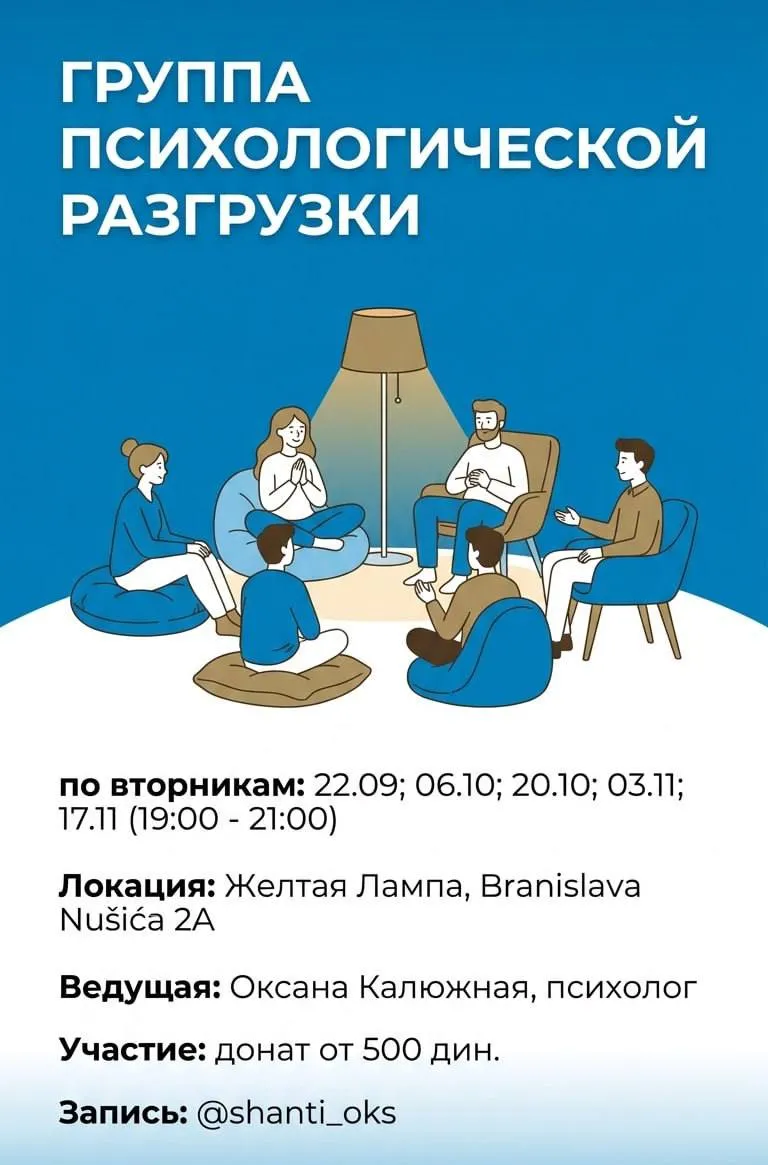
Organizer: Желтая лампа Psychological relief group: a meeting with body, breathing and art-therapeutic practices to relieve tension and restore resources. Led by psychologist Oksana Kalyuzhnaya. Donation from 500 RSD, up to 10 participants, group will take place if at least 4 people sign up. This announcement was found and posted by KiddoDoo editors. Like it and we will find out all the details and exact schedule. Hello everyone! We invite everyone interested to a psychological relief group on TUESDAY, 22 September at 19:00 and on TUESDAY, 6 October 2026 from 19:00 to 21:00 📍Location: Zhelta Lampa (Yellow Lamp), Branislava Nušića 2A (link) You will be able to 🔵share what is on your mind, 🔵get support, 🔵do body, breathing, and art-therapeutic practices to relieve tension and restore resources. Group safety is ensured by simple rules: 🟠confidentiality 🟠"I don't want to — I don't speak" (you can just be present) 🟠any emotions and feelings have the right to exist 🟠feedback — upon request 🟠we share experience, not advice Facilitator: Oksana Kalyuzhnaya, psychologist with body and art-therapeutic approach Remember: help is necessary for everyone who feels it. Do not judge whether I deserve help or not. Preserve yourself, your strength and health to support your loved ones and live a full life. Price: donation from 500 RSD. Participants: up to 10 people ** Please register in advance - in the chat under the post telegram link or via private messages telegram link The group will take place with at least 4 people.
Q&A:
Most questions are answered by the organizer, but community members can also answer.
Contacts
Kiddodoo MessagesSchedule & Booking:
We verified the schedule less than 24 hours ago. Book with confidence, guaranteed best price.
Skills & Interests
Managing emotional responses constructively; not suppressing emotion or controlling every impulse.
more «Emotional regulation» →Recognizing one's emotions, strengths, needs, and reactions; not body awareness.
more «Self-awareness» →Recovering and re-engaging after failure, loss, or setback; distinct from effort before a setback.
more «Resilience» →Activities designed to help children express and understand their emotions in a safe, caring atmosphere. With guidance from a trained psychologist, they explore creative ways to cope with stress, build self-confidence, and feel understood.
more «psy_support» →What it is: Calm is a settled present feeling with relatively little tension. Why it matters: it can give a child room to recover, notice what is happening, and participate without feeling rushed. When it rises: the child may feel more at ease and less activated. When it lowers: tension or activation may be becoming more present; this is not automatically a problem. Why this is the same: peaceful, at ease, and relaxed describe Calm when they refer to the same settled emotional state. Why this is different: Rest is something the child may need, Low energy is depletion, and inactivity is only a behaviour; none necessarily means the child feels calm.
more «Calm» →Recognizing stress signals and using safe, age-appropriate strategies or support to return to a manageable state; not absence of stress, relaxation alone, or treatment.
more «Stress management» →Where?

Run activities for kids?
Reach families who are a real match. Post your classes, camps and programs to the open catalog. Kiddodoo shows them to parents whose children are genuinely exploring what you offer, not just anyone within 5 km.
Get startedThis page is from the Kid-do-doo app. Install the app to see the details.
Parenting, made clearer — and less scattered
Understand what may be happening with your child — and find real-world ways to support the next step.
This page is from the Kid-do-doo app. Install the app to see the details.
Parenting, made clearer — and less scattered
Understand what may be happening with your child — and find real-world ways to support the next step.
Schedule:
We verified the schedule less than 24 hours ago. Book with confidence, guaranteed best price.
About
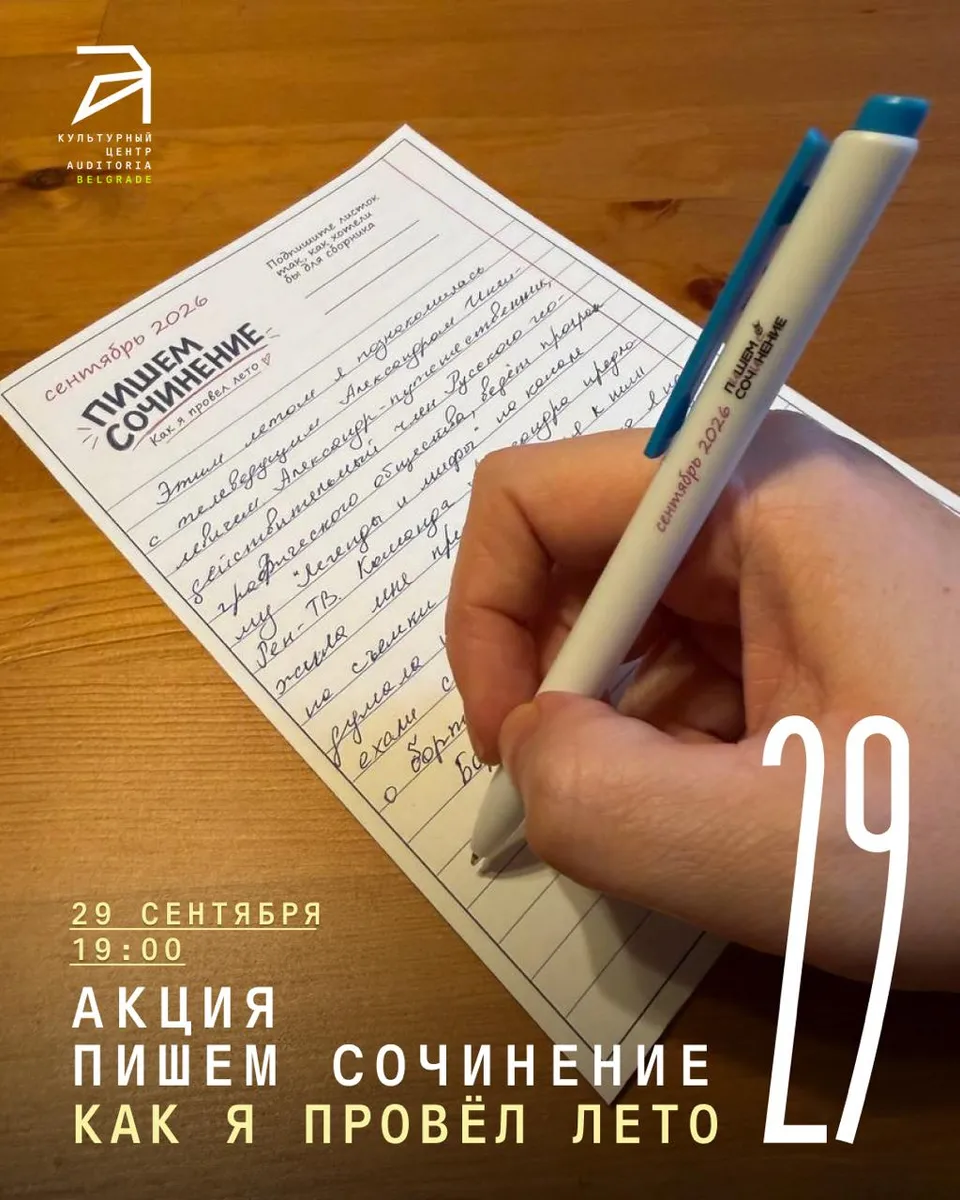
Organizer: Auditoria Belgrade Return to school for one evening: 40 minutes to write by hand the essay “How I Spent the Summer” to a specially curated summer mix. No criticism, grades or internet; pens and paper provided by the organizers. Participants who wish can read their pieces aloud, followed by a group conversation. Participation by donation and prior registration; limited places. Venue: Vojvode Dobrnjca 48, Beograd. This announcement was found and posted by KiddoDoo editors. Like it and we will find out all the details and exact schedule. ✍️We write an essay “How I Spent the Summer" Remember that feeling: a blank page, a pen, concentration and only 40 minutes to simply recall how your summer went? We invite you to return to school for one evening, but without tests, grades or red ink on the margins. Auditoria supports the “We write an essay” action (telegram link) and invites you to write about summer for the standard 40 minutes together. By hand, on paper, to a specially compiled summer mix. No criticism and no grades. No rush and no moralizing. No internet and no neural networks. Just you, a pen, a sheet of paper and the chance to calmly remember how your summer went. Anyone who wants to may read their piece aloud. We will finish with a group conversation about how it felt. Pens and paper are on us, memories are on you! 🗓 29 September (Tuesday) 19:00 🎫 Participation: donation with prior registration (link) via the link (link) (places are limited) 📍Vojvode Dobrnjca 48, Beograd (link)
Q&A:
Most questions are answered by the organizer, but community members can also answer.
Contacts
Kiddodoo MessagesSchedule & Booking:
We verified the schedule less than 24 hours ago. Book with confidence, guaranteed best price.
Skills & Interests
Recognizing one's emotions, strengths, needs, and reactions; not body awareness.
more «Self-awareness» →What it is: Expression is the child's current need for an outlet for feelings, ideas, experiences, imagination, or identity. Why it matters: meeting it can help a child process experience, make themselves understood, exercise agency, and contribute something personally meaningful. When it rises: the child may have something they want to communicate, create, show, or embody without a suitable outlet. When it lowers: verbal, creative, musical, physical, dramatic, or symbolic expression may have helped meet the need. Why this is the same: these different forms belong together because each gives inner experience an outward form. Why this is different: Communication and Creativity are transferable abilities that can develop through expressive activities; they are not the child's current need for an outlet.
more «Expression» →Expressing and receiving meaning appropriately; includes speaking and active listening.
more «Communication» →Sustaining attention and filtering distractions; includes focus and concentration.
more «Focused attention» →Generating and developing original, useful ideas or expressions; includes applied imagination.
more «Creativity» →Where?

Run activities for kids?
Reach families who are a real match. Post your classes, camps and programs to the open catalog. Kiddodoo shows them to parents whose children are genuinely exploring what you offer, not just anyone within 5 km.
Get startedThis page is from the Kid-do-doo app. Install the app to see the details.
Parenting, made clearer — and less scattered
Understand what may be happening with your child — and find real-world ways to support the next step.
This page is from the Kid-do-doo app. Install the app to see the details.
Parenting, made clearer — and less scattered
Understand what may be happening with your child — and find real-world ways to support the next step.
Schedule:
We verified the schedule less than 24 hours ago. Book with confidence, guaranteed best price.